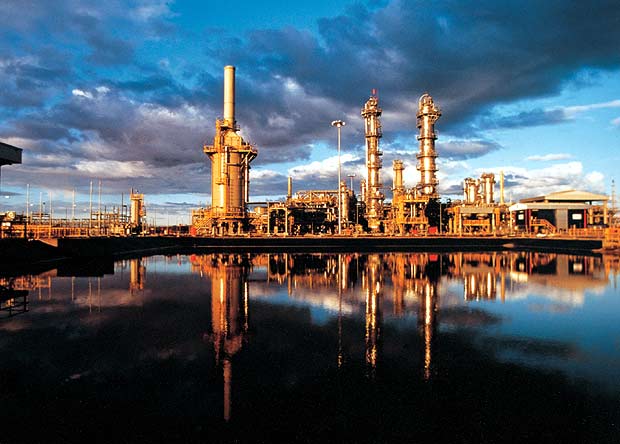
In Campo Duran in the province of Salta, is the only refinery north of the country, Refinor, to receive crude oil and natural gas from the west basin and Bolivia, through two pipelines, one pipeline and a pipeline. Thus, Campo Durán has become a hub for Latin American products and is the most important distribution channel for all liquids that are generated in the Northwest Basin of Argentina.
processes that take place in our distillery
Refinor is a leading integrated business links in the Oil and Gas North Argentino.Las Refinor activities that are present are:
• Oil Refining • Gas Industrialization
• Transportation Product Marketing and Sales
• Petroleum Refining and Processing Gas
For products that are then marketed, Refinor account with the following processing plants:
• An atmospheric distillation unit oil (Topping).
• A vacuum distillation unit.
• A naphtha hydrotreating unit.
• A catalytic reforming of naphtha (Reforming).
• Two processing units of gas fractionation turboexpansión and LPG (Liquefied Petroleum Gas as its acronym in English)
• In addition to a production facility and ancillary services (industrial water, steam, electricity, air) used in different processing plants . Topping as
Both Vacuum and Physical Turbex are processes where hydrocarbon fractions separated from oil or gas, the difference of boiling points thereof. In the only process where chemical reaction is in Reforming, where modification of the molecules of a virgin naphtha cut, we aim to obtain a product with improved properties for motor gasoline.
Topping Topping is an unconventional features 4 fractionation towers, where the products are separated by difference in boiling points, trying to optimize the quality of the various cuts, as well as the performance thereof.
crude oil purchased by Refinor is stored in tanks and then preheated in a heat exchange network, in order to use the energy available in hot process streams and then are heated in an oven, where it reaches temperature needed for distillation, which takes place in a particular arrangement of the 4 towers getting columns:
• LPG, which is charged to the fractionation of Turbex
• Nafta Virgin
• Gas Oil, Heavy
• Vacuum Gas Oil (paraffin)
• Fuel Oil. Reforming
is a plant in which there is a catalyzed chemical reaction, which converts a low-octane gasoline in a gasoline high octane number thus improving the compression self-ignition resistance.
The adaptation process is a naphtha stream will be charged to the reforming reactor, so removed that deactivate the catalyst components (sulfur, nitrogen compounds, arsenic, etc.), then the current is heated first to a network heat exchange and then an oven to be charged to the reactor where it finally adjust the structure of the molecules of the virgin naphtha charged, resulting in a hydrogen-rich gas stream and a liquid stream is conditioned before being stored in tanks for further transport. Turboexpanders
fractionation
This process is Natural Gas from the wells, which is cooled to obtain a liquid stream, and then separate the components in the process of fractionation.
This process involves the following steps:
1. Dehydration of the load.
2. Expansion of gas for their energy and cool the gas stream until the liquid cargo which is then fractionated.
3. Compression of residual gas being returned to producers to be transported (TGN) to consumption centers.
fractionation step in loading the liquid stream obtained in step turbo expansion in the liquefied components are separated in the previous stage, from the most volatile to less volatile than distillation towers, obtaining:
1. Ethane (which is mixed with methane gas from the previous stage to be compressed and returned to the producers)
2. Propane and butane (which are stored in liquid spherical tanks)
3. Gasoline Finally, mixed with the virgin naphtha Topping.
Here I leave a few pages to know about the oil in Salta
production increases in Salta
price of oil in Salta


0 comments:
Post a Comment